|
Everything You Need to Know About Categorical Propositions
Sandra LaFave
This handout summarizes Hurley's Chapter 4.
You should know that many university-level classes in introductory logic -- especially those that contain the words "formal" or "symbolic" in the course title -- don't include any of the material in Chapters 4 and 5 of Hurley because modern logicians generally consider that material inelegant and outdated. I never encountered any of this material in any logic class, undergraduate or graduate, until I had my Ph.D., got a teaching job, and was assigned to teach this class using this textbook! If your class gets to Chapters 6-8 of Hurley, you will see that you will be determining the validity and invalidity of the same arguments in both systems, but you will use different methods. The methods of Chapters 4-5 make you better at thinking in words and pictures. Chapters 6-8 introduce you to the formal systems that underlie computer science. Hurley does an excellent job all around.
Why do these chapters persist in textbooks? For one thing, they explain a lot about the history of logic. They are also excellent for improving reading focus and comprehension, so they are often used in "Critical Thinking" classes. Also, many students have math anxiety, and can be intimidated by the special symbolism in Chapters 6-8. Venn diagrams, which are widely used in Chapters 4-5, came along many centuries after traditional logic was established, but they are included because they seem intuitive and relatively unintimidating to many students.
Of all the topics in Chapters 4-5, the contradictory relation remains important, however, because it maps directly onto the negation function (used extensively in Chapters 6-8 of the Hurley text, and also in computer circuitry).
Categorical Statements
Categorical statements always begin with one of the following three quantifiers: “all”, “no”, or “some”. The subject term (Ss) and predicate term (Ps) must be general terms, i.e., plural nouns or noun phrases. The verb is always the same: it is “are”, understood in the copulative sense of the verb “to be”. The word “not” appears in the O proposition only, after the word "are" (the copula). There are four categorical statement forms:
The statement form "All Ss are not Ps" is never used in logic because its meaning is unclear. Suppose your doctor says "All your test results are not good results". Does that mean all your test results are bad? Or some of your test results are bad? (It would make a difference if you were the patient, but from the statement alone, you can't determine the meaning.)
The affirmative categoricals (A and I) are named from the Latin word “affirmo”. The negative categoricals (E and O) are named from the Latin word “nego”.
A term is distributed in a categorical if the statement says something about all the members of the class denoted by the term.
Mnemonics for remembering distribution:
Aristotelian vs Boolean Interpretations of Universals (A and E)
The interpretation of universals (A and E) is different in the traditional (Aristotelian) and modern (Boolean) approaches.
The Aristotelian interpretation of A is “If anything is an S, it’s a P; and Ss exist.” The Aristotelian interpretation of E is “If anything is an S, it isn’t a P; and Ss exist.”
The Boolean (modern) interpretation of A is “If anything is an S, it’s a P”. We don’t assume by default that Ss exist. Maybe they do; maybe they don't. The Boolean (modern) interpretation of E is “If anything is an S, it’s not a P”. Again, we don’t assume by default that Ss exist. Maybe they do; maybe they don't.
Why There are Two Different Interpretations of A and E
Both interpretations (traditional and modern) of the universals (A and E) have their uses.
People regularly make categorical statements about things that really exist, e.g. "All apples are fruit." We're as certain as we can be that apples exist, so no difficulties arise if we explicitly append "and apples exist". The advantage of adding "and apples exist" is that explicitly acknowledging the existence of apples enables us to reason confidently -- that is, to determine the validity or invalidity -- of immediate inferences from the categorical forms alone. (An immediate inference is an argument with a single premise.) The valid immediate inferences are summarized in the traditional Square of Opposition (more on this below). For example, if it is true that "all apples are fruit" (a categorical of the A form) in the traditional sense, you can confidently and correctly infer the I statement that there exists at least one thing that is both an apple and a fruit. In other words, any A in the traditional sense implies the corresponding I statement. Another example: if it's true that all apples are fruit in the traditional sense, you can correctly infer that the E statement "No apples are fruit" is false. In other words, on the traditional view, a true A implies a false E.
But people (especially philosophers, scientists, and mathematicians) don’t always talk about things that exist. That's the downside of the traditional interpretation. For example, consider a statement like "All round squares are two-dimensional figures." That statement has a non-denoting term (“round squares”) as its subject term. (A non-denoting term is a term denoting a class that has no members, i.e., the empty set. The term "round square" is non-denoting because it is impossible for a figure to be both round and square at the same time, so the set of "round squares" is empty.) But on the traditional interpretation of A statements, the statement "All round squares are two-dimensional figures" would mean "All round squares are two-dimentional figures, and round squares exist." Another example: People in the Middle Ages might confidently assert the A statement “All unicorns are one-horned animals”. The traditional interpretation of that A statement would be "If anything is a unicorn, it is one-horned, and unicorns exist." Something is clearly wrong with the traditional interpretation of A in cases like these.
Here is where the modern (Boolean) approach comes in handy. Philosophers, especially philosophers of religion, occasionally talk about things that are logically impossible (round squares, "the time before there was time").[ MAKE THIS A FOOTNOTE: There are interesting philosophical implications for philosophy of Western religions here. The Abrahamic religions presuppose a logos God: a God who made a consistent logical universe. The logical principle of non-contradiction -- nothing can simultaneously be and not be the same thing in the same sense at the same time -- seems to apply to everything! If the universe didn't run according to logical principles, math would not work to describe and predict events in the world. For believers, it is because God follows the rules of logic that we can apply math successfully to the world.] And people talk about things that most likely don't exist according to our current understanding of science (leprechauns, disembodied spirits, continuity of consciousness after brain death). People also like to talk about things whose existence is logically possible but currently unknown (ghosts, humans over ten feet tall, extra spatial dimensions beyond the current three, ETs). In fact, scientists often hypothesize that completely new classes of things exist -- for example, gravitons (hypothetical particles of gravity), or axions (hypothetical ultra-light subatomic particles) -- because if those hypothetical things existed, certain scientific problems would be solved. Sometimes those hypothetical things turn out to actually exist (e.g., atoms, DNA) and sometimes they don't, (e.g., the "life force", phlogiston). Philosophers ask even more fundamental questions about existence. "What is reality?" "What does it take to be real?" When philosophers do metaphysics, they are looking for the criteria that allow you to say something exists in the first place. Philosophers are generally cautious about assuming, without good reasons, that anything exists. Philosophers, too, often ask "What if?" questions. We often assume the existence of things for the sake of the argument (things like Twin Earth, the Chinese Room, the ship of Theseus), even though we know those things don't exist in reality. So it often makes sense not to assume existence. In such cases, we should use the Boolean interpretations of A and E statements.
How to Make Venn Diagrams for A and E, Traditional and Modern
In Venn diagrams, each term gets a circle and the circles intersect. Each categorical statement contains two terms, S and P. So to make a Venn diagram with 2 terms, we begin with two intersecting circles. (Looking ahead: in Chapter 5, we will be looking at syllogisms, which contain 3 terms. So Venn diagrams for syllogisms will require 3 intersecting circles.)
Venn diagrams for single categorical statements always start with a diagram like this:
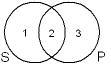
Area 1 is the area of things that are S but not P. Area 2 is the area of things that are both S and P. Area 3 is the area of things that are P but not S. Area 4 is everything outside the intersecting circles (the white space surrounding the intersecting circles). It is often not labelled.
To mark a Venn diagram, you either (1) shade an area OR (2) make a circled X in the area OR (3) make an uncircled X in the area OR (4) leave the area blank.
Let's begin with the diagram for the modern E ("No Ss are Ps").
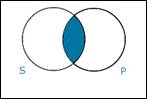
Area 2 (the middle convex area) is the intersection of S and P. If anything were in this area, it would be both S and P. But the modern E statement says that no Ss are Ps: in other words, nothing exists that is both S and P. So area 2 is empty. We mark empty areas by shading. Therefore, the diagram for modern E simply shades area 2. No Xs -- which indicate existence (non-emptiness) -- are in this diagram because the modern E does not assume in advance that Ss exist. On the modern reading of E, then, area 1 (the only other area that could contain Ss) is left blank. We simply don't know if area 1 has members or not.
Now contrast that with the diagram for the traditional E ("No Ss are Ps and Ss exist"):
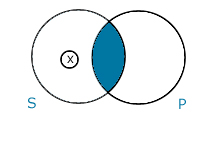
This diagram shows area 2 (the middle convex area) empty, just like the modern E diagram. But the traditional E also supposes the existence of Ss. Ordinarily, Ss might be in area 1 (the left -- Ss that are not Ps) or area 2 (the middle -- the Ss that are Ps), or both. Both the traditional and modern E statements tell us area 2 is empty. But because we are now diagramming the traditional E, which assumes that Ss exist, we need to add that information to the diagram. The only area where Ss could possibly exist now, given that area 2 is empty, is area 1 (Ss that are not Ps). So we need an X there, to show it is non-empty. We use the circled X here because area 1 is non-empty only if you read E in the traditional way, as assuming that Ss exist.
Now let's look at the diagram for the modern A ("All Ss are Ps).
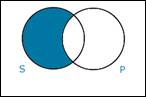
You might find this one more puzzling. Why shade area 1 to represent "All Ss are Ps"? It's because if all Ss are Ps, that means there aren't any Ss that are not P. Area 1 is the area in which things that are S and not P would go, if any existed. But the modern A is telling us that nothing exists that is both S and not P. So area 1 is shaded. Because the modern A doesn't assume Ss exist, we also leave area 2 (things that are both S and P) blank.
Compare this to the diagram of traditional A ("All Ss are Ps and Ss exist"):
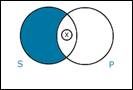
This diagram shows area 1 empty, just like the modern A diagram. But the traditional A also supposes the existence of Ss. Ordinarily, Ss might be in area 1 (the left -- Ss that are not Ps) or area 2 (the middle -- the Ss that are Ps), or both. The traditional A tells us there are no Ss outside P (i.e., area 1 is empty, so shaded). But the traditional A also assumes that Ss exist. The only area where Ss could possibly exist now, given that area 1 is empty, is area 2 (Ss that are Ps). So we need an X there, to show it is non-empty. We use the circled X here because area 2 is non-empty only if you read A in the traditional way, as assuming that Ss exist.
Interpretations of I and O Same in Both Traditional and Modern
The particulars (I and O) have the same meaning in both the Aristotelian and Boolean interpretations. Both I and O make existence claims, and thus have metaphysical as well as logical import. But the traditional view assumes in advance that Ss exist. The modern view does not.
The I statement always means “At least one thing exists that is both S and P”.
The O statement always means “At least one thing exists that is S and not P.”
How to Diagram I and O, Traditional and Modern
Since I and O have the same meaning in both the traditional and modern interpretation, the Venn diagrams for I and O are usually the same in both interpretations.
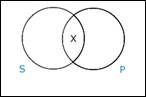
Here is the diagram for I ("Some Ss are Ps).
And here is the diagram for O ("Some Ss are not Ps"):
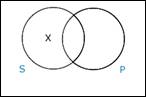
The I and O statements make existence claims. That is, they affirm that something (at least one thing) exists in some area. If something exists in an area, the, area is non-empty. We indicate non-empty with an uncircled X.
The I statement says "at least one thing exists that is both S and P". The non-empty area in the I statement is area 2 (things that are both S and P). The O statement says "at least one thing exists that is both S and not P". The non-empty area in the O statement is area 1 (things that are both S and not P).
Nevertheless, you might find it a little strange that we use identical Venn diagrams for I and O in both the traditional and modern views. Most logic texts do use the uncircled X for I and O , in both the traditional and modern senses. But surely there is a case to be made that the circled X should be used for I and O in the traditional view, since on the traditional view, there is never any question about the existence of Ss -- Ss are always assumed to pre-exist -- whereas on the modern view, Ss are never assumed to exist in advance. Areas that are presupposed non-empty in the traditional view are presupposed empty in the modern view. In other words, a good case can be made that there should be different Venn diagrams for I and O, depending on whether you are using the traditional or modern assumptions. I bring up this point in case it has occurred to you that I and O actually mean different things depending on whether or not you assume the existence of Xs in advance. For consistency, you would use the uncircled Xs only when using the modern view. This is not something beginning logic students need to worry about; I only mention it here because advanced students occasionally ask about it. If you'd like to explore this little anomaly further, I recommend you ask your favorite AI!
Valid Immediate Inferences in the Traditonal View
I said above that the traditional interpretations of A and E make it possible for you to form a number of useful valid immediate inferences. Those inferences are:
The following table summarizes these valid immediate inferences. The premise is the "if" statement; the conclusion is in the corresponding box in that row. The valid ones are indicated by definite statements (e.g., "O is false", "I is true"). The letter "U" means "Undetermined"; that is, this inference is invalid.
These immediate inferences are usually summarized as the traditional Square of Opposition. The traditional square of opposition is not usually depicted in table form. It is usually shown as an image such as this:
Don't be alarmed that this looks like a diamond, not a square. It is a square, rotated to the left. It doesn't matter for our purposes; all the information is there. It's the same information in the table. Use the diagram or the table, whichever is easier for you.
The Key Terms in the "Square" of Opposition
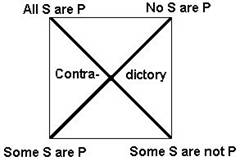
1. "Contradictory"
Two statements are contradictories of each other if they always have opposite truth values.
If one is true, the other is false AND If one is false, the other is true.
In categorical logic, the pairs of contradictories are A and O and E and I.
Looking ahead, the contradictory relationship works just like negation in sentential logic (Hurley Chapter 6).
The two pairs of contradictories (A and O, E and I) are contradictory in both the Boolean (modern) or Aristotelian (traditional) interpretations of the universals. In fact, the Boolean square of opposition (shown below) contains only the contradictories. So the modern square of opposition is much simpler than the traditional square. It looks like this:
Here's the modern square of opposition in table form. In each row the truth values are just opposite truth values.
In the modern interpretation of A and E (not assuming Ss exist),
the contradictories (and only the contradictories) are
actually more than valid inferences (True A implies False O, True E implies false I, etc.).
These are inferences valid in both directions. (Note how in the table above, lines (1) and (8)
show the same inferences in the opposite direction. The same goes for lines (2) and (7),
(3) amd (6), and (4) and (5).)
On the modern view, then, these logical equivalences mean exactly the same thing and always can be substituted for each other. Their Venn diagrams are also identical.
In fact, the Venn diagrams make these logical equivalences almost impossible to miss! Remember that in Venn diagrams an area is either empty or non-empty. So if a diagram shades an area, indicating the area is empty, then if the original statement is false, that same area is now non-empty. The modern Venn diagrams for A and O, for example, both concern area 1: A says area 1 is empty while O says area 1 is non-empty. Area 1 is either empty or not; there are no other options. So a false A (an X in area 1) is a true O (an X in area 1); and true A (shaded area 1) is a false O (shaded area 1). Same is true for E and I, which both concern area 2: a false E (X in area 2) just is a true I (X in area 2), and a false I (shaded area 2) is a true E (shaded area 2). So "true A" and "false O" are logically equivalent.
Why might this be important for you? Logical equivalences are important for translating English statements into categorical statements. Statements of the form "It is false that (any catgorical)" are not categoricals as written, because a genuine categorical must be in A, E, I, or O form. But because a false O is logically equivalent to a true A, you can simply translate "It is false that some Ss are not Ps" (a false O) to the equivalent genuine categorical "All Ss are Ps" (a true A). Likewise, you can always translate "It is false that some Ss are Ps" (a false I) to the corresponding logically equivalent statement "No Ss are Ps" (a true E), and so. Remember these logical equivalences always work in both the tradional and modern interpretations of A and E.
2. "Contrary"
The contrary relationship holds only between A and E in the traditional (Aristotelian) interpretation. Two statements are contraries of each other if
There is NO contrary relationship between modern (Boolean) A and E, .
Here’s why A and E are contraries in the traditional Aristotelian view. Look closely at the diagrams for traditional A and E. Here is traditional A:
Here is traditional E:
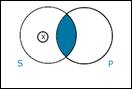
If the traditional A proposition ("All Ss are P" and Ss exist") is true, then area 2 is non-empty, which means that E (which claims area 2 is empty) must be false. Likewise, if the traditional E ("No Ss are Ps and Ss exist") is true, area 1 is non-empty, which means A must be false. Thus if A is true, E is false, and if E is true, A is false. This demonstrates that for traditional A and E, if one is true, the other is false.
But for tradional A and E, if one is false, we still don't know the truth value of the other. They might both be false! We can easily think of logical analogies that demonstrate the possibility that an A and an E can both be false. For example, assuming college students exist, the I statement “All college students are female” and the E statement "No college students are females" are in fact both false.
A and E are NOT contraries in the Boolean interpretation, however, since the Boolean A diagram shades area 1 only, and the Boolean E diagram shades area 2 only. The diagram for A contains no information about area 2, and the diagram for E contains no information about area 1.
3. "Subcontrary"
Two statements are subcontraries of each other if
In categorical logic, there is one pair of subcontraries: I and O in the traditional interpretation only. There is no subcontrary relationship between any two categoricals in the modern view.
In categorical logic (both traditional and modern) I and O statements presuppose the existence of Ss. This presupposition enables us to prove the first element of the definition of subcontraries ("If one is false, the other is true"). If Ss exist, any individual S must be either a member of P or not a member of P. If Ss exist and I is false (no S is P), then if Ss exist, the existing Ss must be not-P. In other words, some Ss are not P. In the same way, if Ss exist and O is false, we're saying that any existing S must be P. In other words, some Ss (at least one) are Ps. So for both I and O, if Ss exist, if one is false, the other must be true.
But what about the seoond part of the definition of subcontraries? How do we know that if I or O is true, the truth value of the corresponding O or I is logically undetermined?
Many beginning logic students find this part harder to understand. They try logical analogies first, i.e.,. they try to think of a real-life argument from I to O, or from O to I, in which one of the statements is true, but the corresponding statement is false.
It is possible to come up with logical analogies that demonstrate that if an I is true, the corresponding O might be false. For example, the I statement "Some circles are round" is true, while the corresponding O statement "Some circles are not round" is false. Because the I premise "Some circles are round" is true, and the corresponding O conclusion ("Some circles are not round") is false, we know immediately that something is wrong with the argument form: true I cannot logically guarantee true O. But you might object: isn't it odd that we need to use a more or less odd I statement ("Some circles are round") to show this? Does anyone really ever say "Some circles are round" when in most contexts it would be much more natural to say the universal A "All circles are round"? I'd agree with you there.
In fact, real-world examples of true-I/false-O don't easily come to mind, since most of the time, if an I is true, the corresponding real-world O is also true! For example it is true that "Some dogs are Chuhuahuas" and it is also true that "Some dogs are not Chihuahuas". This causes many students to think (mistakenly) that a true I does guarantee a true O, and thus they have trouble believing the second half of the definition of subcontraries -- "If an I or O is true, we don't know the truth value of the other".
To clear up this confusion, we need to review some first principles of logic. The fundamental question for logic is never simply whether the statements comprising the argument are actually true. An argument can be logically correct (valid) -- or logically incorrect (invalid) -- even if one or even all the statements comprising the argument are actually false. To determine logical correctness, you don't even need to know the actual truth values of any of the statements comprising the argument. The question in logic is always: if the premise(s) were true (whether or not they actually are), would the conclusion have to be true?
You're not using logic when you say some dogs are Chihuahuas and some are not. You are just reporting some things you happen to know about the world. But logic is never about merely noticing or reporting what is so, or what you believe is so. Rather, logic tells us whether one statement, or one set of statements (AKA premises) implies another statement (the conclusion). That is, logic tells us when we can (and when we can't) be certain that the truth of the premise(s) alone (without resorting to extra world-knowledge) guarantees the truth of the conclusion.
The rules for Venn diagrams conform to philosophers' understanding of logical correctness. Using Venn diagrams, we can easily show that if an I statement is true, we still don't know the truth value of the corresponding O statement. If an I is true, we put a circled X in area 2, indicating that the area is non-empty only on the traditional assumption that Ss exist. But we leave area 1 blank. Logic dictates that we are not automatically allowed to also put an X in area 1, even if we have real-world knowledge that area 1 is non-empty. Putting a circled X in area 1 would state something beyond what we know on the basis of the I statement alone. The diagram for the corresponding O statement tells us to put a circled X in area 1. So if an O statement is true, we put a circled X in area 1, but we leave area 2 blank. We are not allowed to also put an X in area 2, even if we have real-world knowledge that area 2 is non-empty. The Venn diagram for I is simply silent about whether the corresponding O is true or false. The Venn diagram for O is similarly silent about whether the corresponding I is true or false. This is exactly the result we want if we have the correct understanding of what logic does.
To reiterate, there is no subcontrary relation in the modern (Boolean) interpretation of the categoricals. I and O are NOT subcontraries in the Boolean interpretation. Although the modern interpretation assumes that I and O make existence claims, the modern interpretation makes no assumptions in advance about whether any Ss exist. If we don’t assume the existence of Ss, both area 1 and area 2 could be empty.
4. Subalternation
The subalternation relationship is a relationship of implication, i.e., it concerns arguments, where we ask whether the conclusion must be true if the premise is true.
The relationships in these arguments are not commutative; validity only works in one direction, from premise to conclusion.
Here we need to remember that each categorical has quality (affirmative or negative) and quantity (universal or particular).
Valid subalterns of same quality (affirmative), different quantity (particular)
There are two of these:
AND
These two subalternation arguments (A to I and E to O) are valid in the traditional interpretation, because the traditional interpretation assumes that Ss exist. Remember that we are advised to use the traditional interpretation only if we are certain that Ss exist. But if we're sure, there is no problem arguing that, e.g., if all apples are fruit, some apples are fruit.
These same subalternation forms are always invalid on the modern interpretation, however,
because the modern interpretation does not assume in advance that Ss exist.
If we use subalternation on arguments where Ss don't exist, we commit the
Valid subalterns of same quality (affirmative or negative), with false particular premise to false universal conclusion:
There are two of these:
AND
Assuming the same quality, in the second pair of valid subalternations, the premise is always the negation of the particular; the conclusion is always the negation of the universal. Again, these arguments are valid in the Aristotelian interpretation but invalid on the modern interpretation.
Students are often initially puzzled by the second pair of subalterns (false-I to false-A, and false-O to false-E). To explain why these work you need to recall the rules for contradictories and contraries.
Consider argument (1) of the second pair of subalterns: false I implies false A. Here's why it works:
We can show why false O implies false I, in a similar way:
Conversion, Obversion, and Contraposition
You form the converse of a categorical by flipping the S and P terms.
You form the obverse of a categorical by (1) changing the quality (affirmative to negative, or negative to affirmative), leaving quantity (universal or particular) the same; and (2) replacing the P term with its complement non-P. The complement of a term is everything not in the class denoted by the term.
You form the contrapositive of a categorical by (1) flipping S and P terms; and (2) replacing both terms by their complements.
These operations, when they work, demonstrate important logical equivalenves. The following table show when they work.
Sandy's X10 Host Home Page | Sandy's Google Sites Home Page Questions or comments? sandy_lafave@yahoo.com | |||||
